TradingAgents Multi-Agent AI Trading Research
TradingAgents is a focused English entry point for understanding how an agentic market-research framework works: how specialized roles collaborate, how opposing views are surfaced, and how the system turns raw signals into explainable research narratives. Built for research and education. Not investment advice.
The English layer is designed for clarity and discovery before feature sprawl.
Navigation, summaries, SEO, and archives are localized, while the underlying long-form report body still follows the source dataset language.

TradingAgents Report
TradingAgents is the open-source multi-agent research framework. TradingAgents Report is the hosted research desk built on that workflow: evidence modules, Bull/Bear debate, risk review, and a five-tier final rating. Research only. No trade execution.
Visit TradingAgents ReportMulti-exchange coverage
Native listing support for NASDAQ, NYSE, AMEX, OTC, HKEX, TSE, TWSE, and TPEX, with availability controlled by the deployment whitelist.
Structured decision brief
Review conviction, reference price and date, position guidance, key levels, target, and risks in one decision record.
Traceable five-tier rating
Evidence, Bull/Bear debate, and risk review lead to a Portfolio Manager rating: Buy, Overweight, Hold, Underweight, or Sell.
Why this workflow feels different
A more inspectable, debate-driven alternative to opaque market-research pipelines.
Conventional quant or single-agent flow
- Often optimized around historical signals with limited reasoning visibility
- May react poorly to narrative shifts, breaking news, or conflicting evidence
- Tends to compress analysis into one voice with fewer explicit tradeoffs
- Harder to inspect how a final recommendation was formed
TradingAgents framework
- Specialized agents can focus on fundamentals, technicals, news, sentiment, debate, and risk
- The process is designed to expose reasoning stages instead of hiding everything behind one answer
- Contradictory signals can be debated before a synthesis is produced
- Modular design makes the workflow easier to adapt, audit, and extend
A fuller English homepage, without fake parity
The English homepage should carry more of the explanatory weight of the Chinese site, but it should still stay honest about what is and is not localized today.
Multi-agent collaboration
Dedicated roles reduce single-model blind spots by letting different specialists challenge and refine each other.
Multi-market framing
The broader TradingAgents ecosystem is built to reason across China, Hong Kong, and US equity contexts instead of only one venue.
Flexible model stack
OpenAI, Gemini, Qwen, DeepSeek, and similar providers can be evaluated as part of one research workflow.
Readable research output
The framework is oriented toward reports, summaries, and artifacts that humans can review rather than raw model chatter.
Deployment-ready
Docker-friendly setup and modular components make it easier to run the stack locally, in labs, or in cloud experiments.
Risk-aware workflow
The framework leaves room for disagreement, uncertainty, and guardrails instead of pushing every conclusion into false certainty.
How the framework is organized
TradingAgents models a real research organization more than a single assistant. The point is not only to generate an answer, but to make the path to that answer more legible.
Framework overview
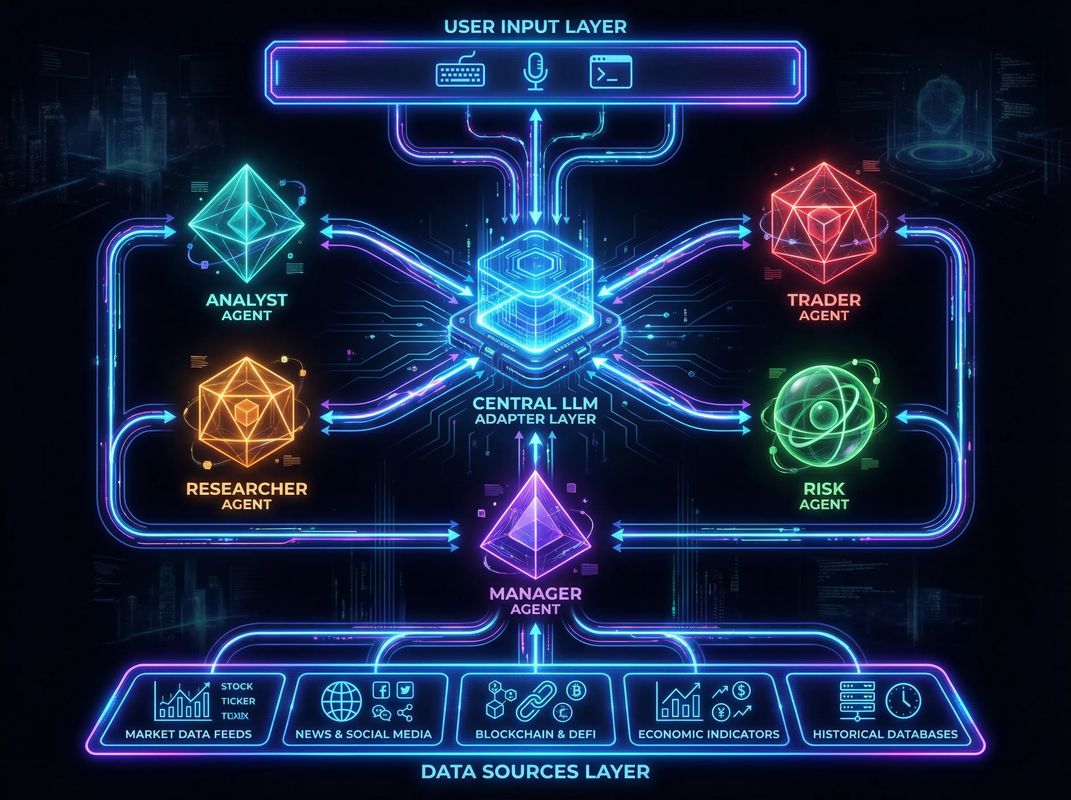
The broader project organizes specialized analyst roles, a research debate layer, a trader, and risk-oriented review into one structured loop. That makes it easier to inspect evidence quality, challenge narratives, and keep uncertainty visible.
Agent specialization
Each role contributes a narrower perspective
Structured debate
Bull and bear reasoning can coexist before synthesis
No forced opacity
Designed for traceable workflows, not black boxes
Modular deployment
Adaptable to labs, demos, and self-hosted experiments

Analyst layer
The analyst layer gathers evidence from distinct viewpoints before any final recommendation is produced.
- Fundamental analyst: Assesses business quality, valuation, and structural strengths or weaknesses.
- Sentiment analyst: Tracks public mood and social signals to detect crowd shifts and narrative pressure.
- News analyst: Reads macro and company news to surface catalysts, events, and contextual changes.
- Technical analyst: Uses indicators and price structure to reason about trend, momentum, and timing.


Research and debate layer
The research layer tests the evidence through opposing viewpoints so the workflow does not collapse into one overconfident narrative.
- Bull researcher: Emphasizes upside scenarios, favorable evidence, and growth cases worth taking seriously.
- Bear researcher: Surfaces downside risk, fragility, and reasons a thesis could fail.
Trader
Transforms synthesized research into a concrete action while preserving the reasoning trail behind it.
Risk manager
Challenges exposure, uncertainty, and downside assumptions before a decision is treated as usable.
Portfolio oversight
Provides final review on how a recommendation fits into broader portfolio-level constraints and priorities.
Platform, deployment, and knowledge layer
The English site should help visitors understand both the technical frame and the practical limits of what is currently localized.
Data and model orchestration
TradingAgents can sit on top of multiple providers, prompts, and market data sources so teams can inspect how stack choices affect output quality.
Knowledge and explanation layer
The `/en` section focuses on product understanding, methodology, research context, and glossary pages that are easier for global users to scan and cite.
Recommended next steps
Read How It Works for the agent workflow.
Open Research for the paper context and research framing.
Review Methodology for scope, caveats, and trust signals.
Browse the Analysis Library for live multi-agent stock reports.
Use the Glossary to unpack indicators and concepts quickly.
Important boundary
The English analysis library lists public reports from TradingAgents Report. Open a card to read the full multi-agent research on tradingagentsreport.com.
This `/en` section is still intentionally scoped around framework, product, methodology, glossary, research context, and a public-report discovery library so the domain can expand internationally without hosting a second copy of every report body.
Key takeaways
- TradingAgents is a multi-agent research framework rather than a single-response chatbot.
- The system is built around explicit roles, structured debate, and risk-aware synthesis.
- The English site lists public TradingAgents Report research and links each card to the full report.
- Full report bodies live on tradingagentsreport.com; this site keeps an English discovery library.
- The project is appropriate for research, education, prototyping, and workflow inspection, not direct investment delegation.
FAQ
Common questions about the English TradingAgents experience.
What is different about the English section?
The English section is not trying to mirror every Chinese page. It is intentionally narrower and focuses on framework understanding, product positioning, methodology, research context, and glossary content for global visitors.
Does the English site include the stock analysis report library?
Yes. The English analysis library lists public TradingAgents Report research. Each card opens the full report on tradingagentsreport.com, including the Portfolio Manager rating, evidence, debate, and risk review.
What kinds of models does TradingAgents work with?
The broader framework is designed around multiple LLM providers and model families, including OpenAI, Gemini, Qwen, DeepSeek, and related configurations depending on the deployment setup.
Who is this framework for?
It is a strong fit for researchers, builders, students, and teams who want to inspect or extend agentic market-research workflows rather than consume opaque one-shot outputs.
Can this be self-hosted?
Yes. The project is designed around practical deployment paths such as local Docker-based workflows and other controlled research environments.
Is this investment advice?
No. TradingAgents is presented for research, education, and financial-technology exploration. Generated analysis and recommendations should not be treated as professional investment advice.
Need more project context?
Learn more about the projectExplore the open-source workflow
TradingAgents is best understood by reading its workflow, inspecting its roles, and following how the open-source project turns market evidence into structured reasoning.